
November 2026
About Shuffling the Shelves →
Publishing as an industry is obsessed with new – books yet to come out… but what about the brilliant books that have already been published? Each month we spotlight a different author whose book was published more than a year ago, which you might be yet to meet…
This month we hear from Erin Clark about the brilliant There’s no Pluto in this Suite…
Assembling There’s no Pluto in this Suite was a real challenge, as its bones were built from a number of ongoing projects or areas of inquiry in my writing. I wanted this collection, since it is my first full-length one, to be a good introduction to me as a poet and an explorer of words, worlds, and the stories between them. I write poems that sometimes tell a story but don’t force a moral of that story. I’m also interested in seasonality, by which I mean ways of keeping time that aren’t the Gregorian calendar or a twenty-four-hour day, which I think comes through in some of the things I write about.
Since Anne Carson’s nomination for the Nobel Prize recently I’ve been reminded of an old Paris Review interview in which she talks about how hard it is to admire writers but do your best not to imitate or even parody them with your current writing project. How do you keep your own voice? is what she’s asking. I think it’s inevitable to some degree that the poets I love influence the type of work I write: Scott Cairns and Toby Martinez de las Rivas have given me a love of juicy opaque words, and trust in the reader to follow you as you exegete them; Karen Solie has a really dusty, environmental black humour and hope that I admire; and I just love poets who can combine very short works/series with big meanings, like Selima Hill. I suppose I should also mention David Scott, without whose ‘parson-poetry’ I would be a far poorer poet, and a poorer parson.
In my writing I’ve often been drawn to playfully examine certain taxonomies, or ways of using words or jargon to lend some sense or order to the world. I love a good poem series that’s based around specialised or technical language and how it unspools its meaning when taken out of its proper context. In There’s no Pluto, there were some poems related to saints, witches or witchy saints, for example. The title alluded both to astronomy and to music, two areas which have their own fascinating and complex language that lends itself well to metaphor.
There were also a handful of poems that took their inspiration from the folk names of British plants. I thought I would offer readers a little treat of a few other poems that belong to this series – ones that were not quite finished when it came time to assembling the manuscript for There’s no Pluto. They are, respectively, a rant about the state of modern dating, a sharp flash of childhood memory and a list poem which is also a riposte to Georgia O’Keeffe’s squeamishness about the sexuality in her paintings. I hope you enjoy them!
meet-her-in-the-entry-and-kiss-her-in-the-buttery
Oi oi! These choreographed courtings,
don’t you prefer them to the swipe-right dance,
to the new prudishness, to the serious youth saying
don’t waste your time, to the sober discussion
of whose kinks are ethical, to the
ghosting etiquette, to sharing of the
cab-app route so we might get ‘safe home’? My home
has a buttery and its heifers sharp horns.
butter-and-eggs
The ones they served at our school at breakfast
came not from a chicken’s withers
but from a red box the size of a toddler,
the text on its side proclaiming A SHELF-STABLE
PANTRY STAPLE RECONSTITUTED
WITH WATER. Under the hot foodlamps
sweet sausage links winked and spat
and we looked out at the blizzarding dark morning
with nitty hair and coarse mute gratitude.
kitty-come-down-the-lane-jump-up-and-kiss-me
She was so insistent, O’Keeffe, that there was nothing genital
about her works. You see in them what you want to see
not what I painted. OK, Georgia. If you insist.
Her lilies were mostly callas, but in England
there is a native cousin a tad less parthenic. Wild arum.
Shockingly sexy. Blooming, its long thin dark spadix
is sheathed comfortably in a spotted green hood, or
spathe. One can call it arum but most people don’t
because unlike O’Keeffe, we like to make as many jokes
as we can about the degree to which flowers resemble
that which we keep covered with our softest
fabrics: Lords-and-ladies. Snakeshead. Devils-and-angels.
Bobbins. Jack-in-the-pulpit. Friar’s cowl.
Bloody-Man’s-finger. Fairy lights. Our Lord and Our Lady.
Cuckoo-pint. Soldier-in-a-sentry-box. Arum lily.
Soldier’s diddies. Stallions-and-mares. Bulls-and-cows.
Adder’s root. Priest’s pintle. Sonsie-give-us-your-hand.
Cheese-and-toast. Cobbler’s thumb. Kings-and-queens.
Portland starch. Devils-and-angels. Toad’s meat.
– Erin Clark, 25 November 2026
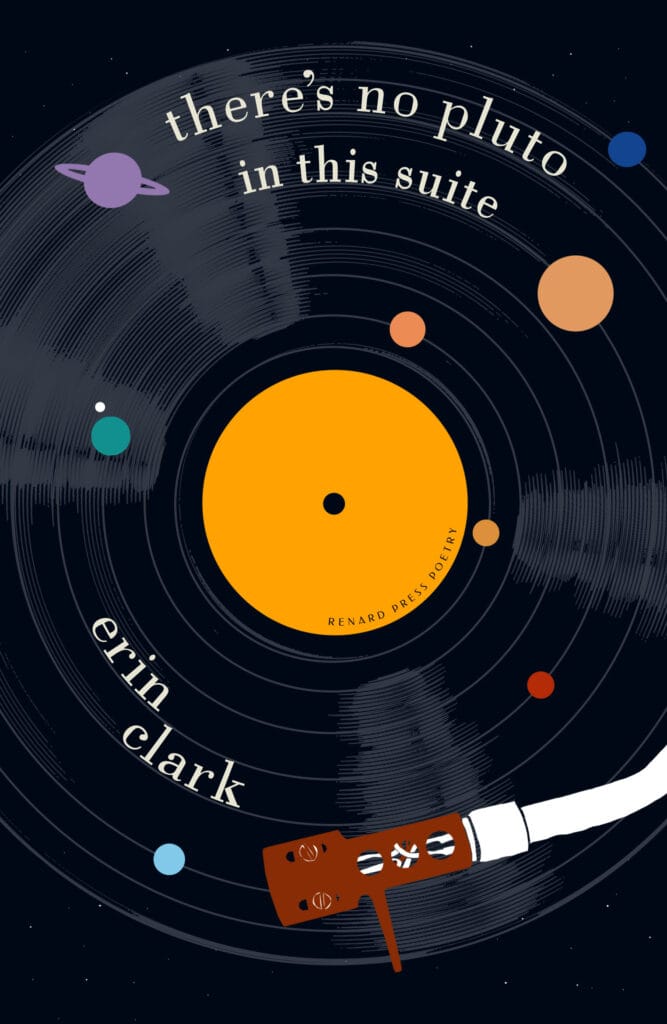
There’s No Pluto in this Suite
Erin Clark
If you want to get back to the beginning
you must fast forward to the end.
I press play, drop into the solar
system à la Holst, somewhere
beyond the asteroid belt,
rocketing ever further out.
The poems in There’s No Pluto in this Suite take the reader to the edges of ordinary experiences, places and narratives and ask them to leap from that ordinariness into the unexpected.
The collection is broken into three parts, and the reader is taken on a ride through verse concerned with the experiences of immigration, travel and transience; then on to a gathering around the hearth, telling stories about what drives humans to live: vocations, love and journeys of discovery; and finally into a mythic realm, encountering holy fools, witchy saints and places of overlap between silly and sacred.
There’s No Pluto in this Suite is a playful collection that blends formal and free verse, lyric and narrative, and in which the profound rubs shoulders with the messy and the patently mysterious.